

THIRST IN A CITY OF PROMISES: KANO’S WATER CRISIS AND THE TRUE TEST OF GOVERNANCE
By Tijjani Sarki
I write from Zawaciki today not just as a public policy analyst, but as a concerned citizen who believes deeply in the ideals of good governance, yet is increasingly skeptical about its delivery in one of the most critical sectors of our state. Across Kano, access to water remains a daily struggle for many, despite years of promises and interventions. I must acknowledge, and thank God, that water runs in my own tap largely due to my proximity to the Challawa Water Treatment Plant,but that comfort does not blind me. If anything, it sharpens my concern about what appears to be a pattern of compromises and underperformance in a sector that should be treated as non-negotiable.
This crisis did not begin today. It is a product of a long-standing backlog that has lingered for decades. Enormous public funds have been budgeted and reportedly spent on water infrastructure, yet the outcomes remain difficult to see, difficult to measure, and even harder to defend. One is left to wonder, where exactly is the impact?
Yes, the Kano State Government has, in recent times, announced interventions, procurement of drilling machines, rehabilitation of key waterworks, and renewed technical efforts. These steps are noted. But as a policy analyst, I must be honest, I am not yet convinced that these actions are translating into meaningful, system-wide change. The gap between announcements and actual service delivery remains too wide to ignore.
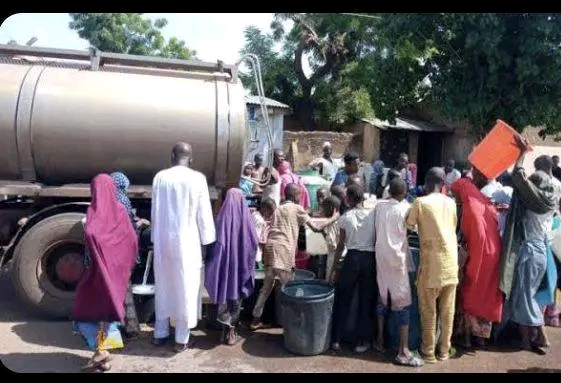
The reality on the ground tells its own story. Entire satellite communities within Kano metropolis still lack pipeline infrastructure. Not damaged systems, simply no systems. Families wake before dawn to secure water. Children carry jerrycans instead of books. Small businesses now treat water as a major operating cost.
This is not a temporary inconvenience. It is a structural failure.
At this point, the need for decisive housekeeping within the leadership of the Ministry and indeed across the entire water sector has become unavoidable, as the widening imbalance between funds expended and the work delivered, coupled with the growing number of areas without pipeline or pipe-borne water, clearly underscores a system in urgent need of reset.
And at the center of that failure is a fundamental governance problem, the absence of measurable accountability. There is no publicly accessible data detailing coverage gaps, no clear mapping of infrastructure deficits, and no time-bound benchmarks tied to budgetary spending. Without these, progress becomes a matter of claims, not evidence.
Predictably, an informal water economy has filled the void, unregulated, inconsistent, and deeply inequitable. Those with the least means pay the highest price. That is not just inefficient governance, it is a quiet form of injustice.
At this point, incremental fixes will not suffice. What is required is deliberate institutional housekeeping within the Ministry responsible for water resources. Leadership must be assessed not by effort, but by outcomes. Where performance cannot be demonstrated, restructuring should not be seen as harsh, it should be seen as necessary.
The path forward is clear, even if the will to act decisively remains uncertain.
I. A comprehensive, verifiable audit of water access across the state.
II.Transparent publication of pipeline coverage and infrastructure gaps.
III. Strict, time-bound targets linked directly to budget releases.
IV.Performance-based evaluation of leadership and agencies.
V. Strategic partnerships to accelerate infrastructure delivery.
Kano does not lack resources. It does not lack relevance. What it appears to lack,at least in this sector, is coordinated execution and measurable urgency.
Governance, ultimately, is not about intentions. It is about results.
And in Kano today, the result is still too many empty taps.
That reality should concern all of us.
Tijjani Sarki
Good Governance Advocate & Public Policy Analyst
Zawaciki, Kano
19th April, 2026